Imagine a school parking lot.
Large blocks of blacktop, separated by thin strips of grass. Not a tree in sight. The pavement absorbs heat and turns into a giant heating pad, raising the temperature in the community around it. Students using the space for gym class have no shade for relief from the sun nor privacy from the curious eyes of passersby.
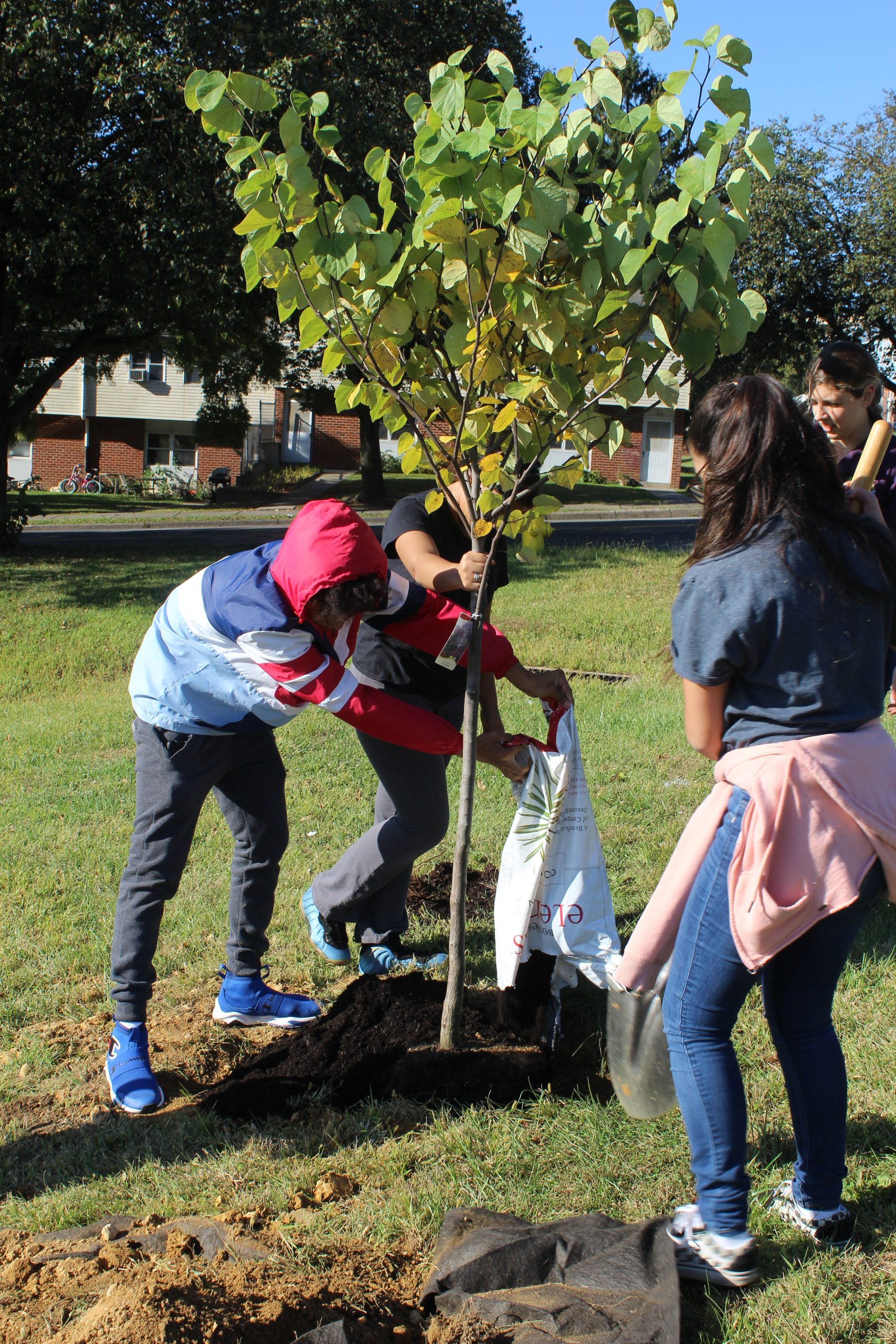
Fast forward 8 years later. Over 20 trees have taken root in those strips of grass, creating shade, privacy, and beauty to this home to almost 600 learners and educators.

How did this transition happen? It came to be through the power of cross-curricular, project-based learning.
It came to be when community stakeholders joined in classroom learning to mentor students and help them see their learning come to life outside the school building. It came to be because students at Building 21 High School in Allentown are shown that their learning is not complete until they can take it out into the community to make an impact. A year after the school’s founding, the freshman class embarked upon a curriculum that combined learning in their environmental science and social studies classes to give students the opportunity to literally transform the landscape of the City of Allentown.
Mentors make a difference.
Science Teacher Ian Hanson and Social Studies Teacher Shannon Salter collaborated with students and a team of educators and researchers from Lehigh University, supported by a grant from the National Science Foundation, to investigate the interaction between people and nature in our community. Using their growing mastery of principles in environmental science, along with their developing awareness of the political, social, and economic infrastructure in our city and county, students prepared and pitched their projects, seeking approval and funding. A group of students chose to advocate for a change on their own campus. They measured the impact of the school’s large, unshaded parking lot on daily temperatures in Allentown. They noted the beginnings of erosion caused by water running down the sloped front yard. They also noticed that they had no shade to rest in nor trees to shield them from the view of passersby as they were outside for gym class. Inside the classroom, they studied data and found a correlation between the presence of trees and higher property values, and lower crime rates.

Students were supported in their learning by a diverse group of mentors representing multiple community stakeholders, including:
- Lehigh University: Whose professors and grad students spent years partnering with our teachers and students to design these learning experiences.
- PPL: Whose arborists generously spent their time with our students, when they weren’t busy traveling to help other communities recover from hurricanes.
- The Lehigh County Conservation District: Who not only joined classes during instruction but also provided a grant which paid for all the trees that would be planted through this project.
- The City of Allentown’s Shade Tree Commission and Department of Public Works: Without whose help and heavy equipment students might still be out there digging the holes to plant those trees!
- And ASD’s facilities staff: who helped see these trees through their early years when both summer break and then a global pandemic meant that no one was on campus to see to their watering.
Each of these community partners also served as the judging panel to which our students had to pitch their ideas. These students – who were only in 9th grade when they faced the Shark Tank – had their projects judged on the appropriateness of the species of trees proposed, as well as the case they made for the environmental, social, and economic benefits of their designs.
Student Impact.
Class of 2021 student Maribel Robayo was the designer whose project design was ultimately chosen for funding and implementation. She was still a student as two sets of plantings brought her vision to life, and now as an alumnus, she can visit campus and see the impact her learning continues to have on her alma mater and the students who have followed her.

Classes continue to learn about the vital role humans play in making choices that contribute to the environmental sustainability of their communities. More importantly, students learn how the things they do in class can empower them to take ownership of the world around them, and to determine the future of their community. Building 21 runs an Urban Agriculture elective, where learning continues about the role we all play as stewards of nature in an environment.
The Growth Continues.
While new tree plantings had to be paused due to the disruptions of the past few years, students have spent time each year caring for the trees and helping them continue to grow. Just last month saw students taking shelter in their shade during a particularly hot and sunny day. It is that work that recently led to Building 21 Allentown being recognized for this work by the Arbor Day Foundation as a National Tree Campus. Work is currently underway to add to the trees already growing on campus, and to extend relationships with community partners to provide students the opportunity to extend the impact of their learning beyond the school’s campus throughout the city.